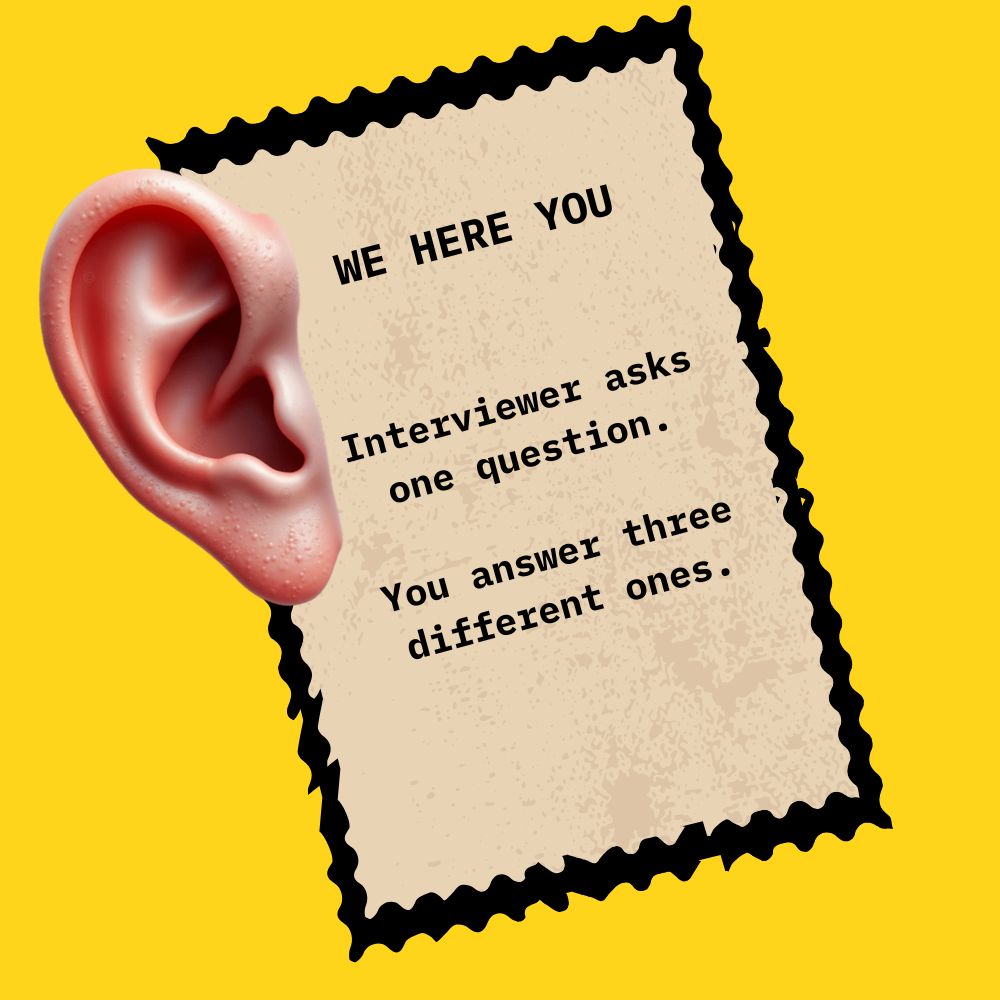
It's not that candidates don't listen. (We fixed that in the last post.)
It's that they listen, they understand the question perfectly, and then they answer from the wrong place entirely.
Here's what we mean:
The Setup: An interviewer asks: "Tell me about a time you had to push back on a decision."
What the candidate hears: Oh no. They think I'm not a team player. They think I don't follow orders. I need to prove I'm collaborative. I need to sound reasonable.
What comes out: "Well, I'm actually someone who respects hierarchy and trusts my manager's judgment. I think it's important to support the team even when you disagree. I've always tried to be flexible and adaptable."
What actually happened: They answered the question they were afraid of, not the question they were asked.
The interviewer asked for a story. A real moment. A decision. A pushback.
The candidate gave them a character reference. A reassurance. A defense against an accusation that was never made.
And the interviewer marked them down.
This is the fear tells. And it costs more offers than bad technical skills ever will.
Why Smart People Do This
You already know you're smart. Your resume proves it. Your experience proves it.
But in an interview, the smart part of your brain goes offline.
Instead, your threat-detection system takes over.
Threat Detection Mode is what happens when you're under stress. Your brain doesn't ask: "What story would actually answer this question?"
It asks: "What assumption might they be making about me? What weakness might they be testing for? What do I need to defend against?"
And so you answer the assumption instead of the question.
A few common examples:
Interviewer asks: "Tell me about a failure." You hear: They think I don't learn from mistakes. They think I'm reckless. You answer: "I've never really failed. I'm pretty careful and thorough." What they actually needed: A real story about something that went wrong, what you learned, how you changed.
Interviewer asks: "Describe your biggest weakness." You hear: They're trying to catch me. They want ammunition. You answer: "I'm a perfectionist. I work too hard. I care too much." What they actually needed: One real, specific weakness and what you're doing about it.
Interviewer asks: "Why did you leave your last job?" You hear: They think I'm a quitter. They think I ran away. You answer: "I loved it there. It was a great company. I learned so much. But I wanted a new challenge." What they actually needed: The actual reason. Growth opportunity. Relocation. Management style mismatch. Salary ceiling. The truth.
Notice the pattern?
When you answer from fear, you answer the negative assumption instead of the actual question.
And that makes you sound exactly like what you're trying not to sound like: defensive, inauthentic, evasive.
The interviewer doesn't think you're more trustworthy. They think you're hiding something.
The Rule (And Why It Actually Works)
We've tested this with hundreds of candidates. The ones who land offers follow this principle:
Answer from experience. Not from fear.
It sounds simple. It is simple. And it works because it does something counterintuitive: it demonstrates character by showing honesty instead of reassurance.
Think about what it signals to an interviewer:
You're confident enough to be honest
You've actually thought about your growth
You're not trying to game the conversation
You're self-aware enough to know what's real about you
That's hire-able. That's the person you want on your team.
The candidates who answer from fear sound like they're interviewing themselves out of the job. The candidates who answer from experience sound like they're already part of the team.
The Formula That Actually Works
Here's the exact structure we coach all Wynisco candidates to use:
Step 1: Pause Before You Answer
Don't open your mouth for 2–3 seconds. Let the question land. Let your nervous system settle.
(Most candidates jump in immediately. Those 2–3 seconds are the difference between answering from fear and answering from experience.)
Step 2: Identify the Real Question
Not the fear beneath it. The actual question.
"Tell me about a failure" = Tell me about a specific time something went wrong.
"Describe your weakness" = Tell me one real thing you're not great at.
"Why did you leave?" = What was the actual driver of that decision?
Say it to yourself. Out loud if you're practicing.
Step 3: Find the True Story
Look for the moment that actually answers it. Not the story that makes you look good. The story that's true.
A real failure. A real weakness. A real reason.
The best interview answers always feel like someone finally told the truth. That's the feeling you're going for.
Step 4: The Structure (Name → Context → What You Did → What You Learned)
Keep it simple. Keep it honest.
"In my last role at [Company], I made a decision to [specific thing]. The assumption I was testing was [why]. But what happened was [actual result]. And here's what I learned: [one concrete insight that changed how you work now]."
That's it. That's the answer.
Step 5: Stop Talking
Pause. Make eye contact. Wait for the next question.
(This is crucial. The moment you've answered the question, your brain will try to add defensive details. Reassurance. Softening. Don't. Stop.)
What Most Candidates Get Wrong
They open with a disclaimer.
"I don't like to talk about failures, but..." "I'm not sure this is a weakness exactly, but..." "I wasn't happy there, and I'm not blaming them or anything, but..."
The disclaimer is the fear talking. It's you defending against an assumption before you've even answered the question.
Remove it entirely.
State the story. State what you learned. Stop.
The cleanest answers have zero disclaimers.
The Practice Drill
Before your next interview, do this:
Find one real story for each of these:
A time you made a mistake. Not a small one. A real one.
One skill you're actually weak at. Not "I'm a perfectionist." Something real.
Why you left your last job. The actual reason, not the polished reason.
Write them down. One paragraph each.
Now read them out loud. Notice where you start adding softeners. Notice where you defensively explain yourself. Notice where you try to make it okay.
Delete all of that.
Then practice the answer 3 times. Each time, get more comfortable with the rawness of it.
Your next interviewer will notice immediately. Not because you sound weak. Because you sound real.
And real is what gets offers.
The Bottom Line
Interviews aren't about proving you're perfect. They're about proving you're honest.
The candidates who sound defensive lose. The candidates who sound defensive and also add reassurance lose twice as fast.
The candidates who answer from experience—who tell the real story, not the polished version—those are the ones who get the call.
Wynisco Inc. has helped 300+ professionals land jobs at top US companies by teaching them to interview like this. We coach you through the fear. We teach you the difference between the question and the assumption. We make you comfortable with honesty in a high-stakes conversation.
If you're preparing for your next big interview, we can help.
Apply here: lnsignup.wynisco.com Follow Sachin Rajgire | Wynisco Inc.
Written by
Sachin Rajgire