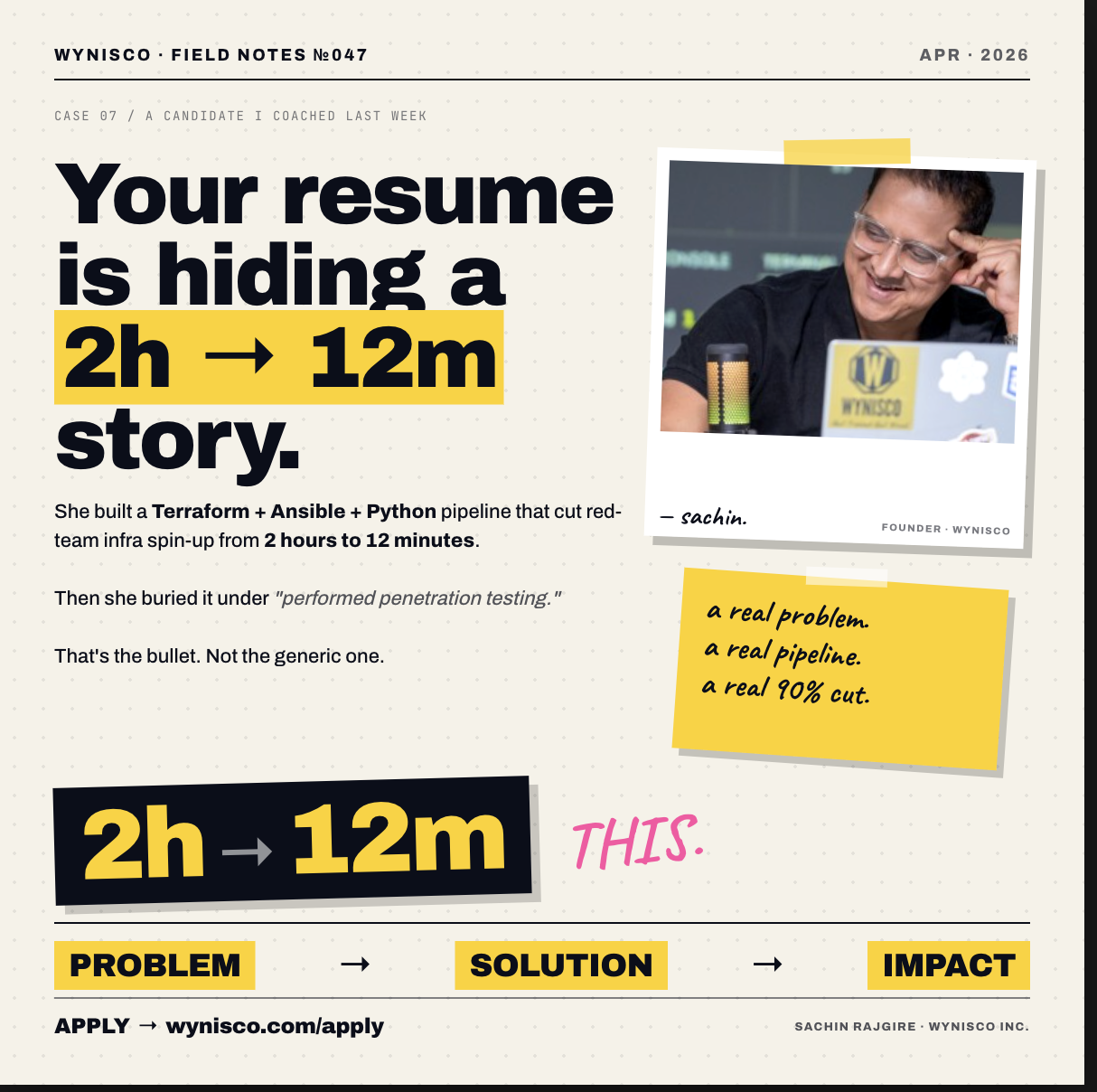
2 hours. Every. Single. Time.
That's how long one of our students spent setting up pentest environments. Manually. Same steps, every engagement, every client. Spin up the VMs. Configure the tooling. Lock it down. Test it works. Then do the actual work — which is the thing she was hired for.
Two hours gone. Before she'd even started.
So she built a fix.
Terraform. Ansible. A handful of Python scripts. Infrastructure as code. One command, the whole stack comes up — configured, secured, ready to go.
12 minutes.
Yes, 12 minutes. From 2 hours.
That's a 90% reduction. In plain English: she got an extra 1 hour and 48 minutes back on every single engagement. Multiply that across a year and you're talking about weeks of her life she just handed back to herself.
Here's the part that killed me
She almost didn't put it on her resume.
When I first read her CV, the whole thing was buried under two generic bullet points. "Performed red team engagements." "Conducted penetration testing." The automation tool — the thing that proved she could see a problem, build a solution, and measure the impact — was a throwaway line at the bottom.
I asked her why.
She said: "I didn't think it mattered. I built it to make my own life easier."
That's the thing nobody tells you. The projects you build to make your own life easier.. those are the ones hiring managers are looking for. Because that's what the job is. Nobody pays you to follow a checklist. They pay you to notice when the checklist is stupid and fix it.
The formula every project on your resume should follow
Here is the entire thing. It's not complicated.
Problem → Solution → Impact.
That's it. Three parts. Every project on your resume should be able to answer all three:
What was the problem?
Not a vague "inefficiency." A specific, measurable pain. "Setting up a pentest environment took 2 hours of manual work before every engagement."
Real. Concrete. You can picture it.
What did you build?
The technical meat. Not a buzzword soup — the actual stack. "Built an automation pipeline using Terraform for infrastructure provisioning, Ansible for configuration management, and Python scripts for custom validation."
If a reviewer can't tell what you actually touched, they move on.
What was the impact?
A number. Always a number. Not "significantly improved efficiency." Not "saved time." A number.
"Reduced environment setup from 2 hours to 12 minutes — a 90% reduction in pre-engagement overhead."
That's the line that gets you the interview.
Why this works (and why most students get it wrong)
Most resumes are written in "job description" voice. "Responsible for..." "Performed..." "Conducted..." It reads like a list of things that happened in the vicinity of the candidate. You can't tell if the person was the one doing the work or just sitting in the same room.
Problem → Solution → Impact flips that. It forces you to write as the person who owned the thing. You saw it. You fixed it. You measured it.
The reviewer doesn't have to imagine what you contributed. You told them.
And when they compare your resume to the 400 other ones sitting in the pile.. yours is the only one with a real, measurable number attached to a real, measurable problem.
Guess which one gets the callback.
One thing to try today
Open your resume. Pick the first bullet under any project or job. Ask yourself three questions:
What was the specific problem I was solving?
What did I actually build or do?
What measurable change did it produce?
If you can't answer all three in one sentence each.. rewrite the bullet. Move the strongest one to the top.
If you've got a "2 hours to 12 minutes" story hiding in your resume, bring it to the top. It's the line that does the heavy lifting.
At Wynisco, we've placed 800+ professionals into roles at companies like JP Morgan, Amazon, Microsoft, and Meta. Average time to placement is 52 days. Average salary is $95K. We do it by rewriting resumes the way hiring managers actually read them — and by standing with our students the whole way through.
Nobody fights harder or longer for you than Wynisco Inc.
Written by
Sachin Rajgire